WWW.VOLCANICLAKES.COM

Library

Muons and volcanoes.

Cosmic Flux: Geiger Counter

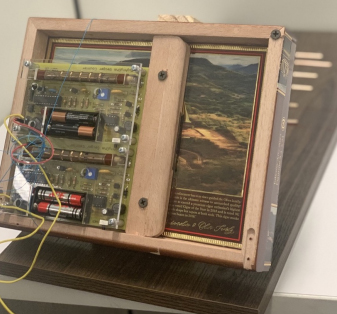
In this experiment, we built Geiger Counters that detect various types of ionizing radiation: Beta particles, Muons, and Gamma rays. Using the coincidence method with the Geiger counter’s interface, we designed a method to measure the respective flux of cosmic radiation through a conical range produced when the two counters are arranged in coincidence. We calibrated the Geiger Counter using a test source.


Muon tomography applied to active volcanoes.


Muon tomography is a generic imaging method using the differential absorption of cosmic muons by matter. The measured contrast in the muons flux reflects the matter density contrast as it does in conventional medical imaging. The applications to volcanology present may advantadges induced by the features of the target itself: limited access to dangerous zones, impossible use of standard boreholes information, harsh environmental conditions etc. The Diaphane project is one of the largest and leading collaboration in the field and the present article summarizes recent results collected on the Lesser Antilles, with a special emphasis on the Soufrière of Guadeloupe.


Muography as a new complementary tool in monitoring volcanic hazard: implications for early warning systems


Abstract

Muography uses muons naturally produced in the interactions between cosmic rays and atmosphere for imaging and characterization of density differences and time-sequential changes in solid (e.g. rocks) and liquid (e.g. melts ± dissolved gases) materials in scales from tens of metres to up to a few kilometres. In addition to being useful in discovering the secrets of the pyramids, ore prospecting and surveillance of nuclear sites, muography successfully images the internal structure of volcanoes. Several field campaigns have demonstrated that muography can image density changes relating to magma ascent and descent, magma flow rate, magma degassing, the shape of the magma body, an empty conduit diameter, hydrothermal activity and major fault lines. In addition, muography is applied for long-term volcano monitoring in a few selected volcanoes around the world. We propose using muography in volcano monitoring in conjunction with other existing techniques for predicting volcanic hazards. This approach can provide an early indication of a possible future eruption and potentially the first estimate of its scale by producing direct evidence of magma ascent through its conduit in real time. Knowing these issues as early as possible buy critically important time for those responsible for the local alarm and evacuation protocols.


Abrupt changes of hydrothermal activity in a lava dome detected by combined seismic and muon monitoring


Abstract

The recent 2014 eruption of the Ontake volcano in Japan recalled that hydrothermal fields of moderately active volcanoes have an unpredictable and hazardous behavior that may endanger human beings. Steam blasts can expel devastating ejecta and create craters of several tens of meters. The management of such hydrothermal events in populated areas is problematic because of their very short time of occurrence. At present no precursory signal is clearly identified as a potential warning of imminent danger. Here we show how the combination of seismic noise monitoring and muon density tomography allows to detect, with an unprecedented space and time resolution, the increase of activity (at timescales of few hours to few days) of a hydrothermal spot located 50 to 100 m below the summit of an active volcano, the La Soufrière of Guadeloupe, in the Lesser Antilles. We show how the combination of those two methods improves the risk evaluation of short-term hazards and the localization of the involved volumes in the volcano. We anticipate that the deployment of networks of various sensors including temperature probes, seismic antennas and cosmic muon telescopes around such volcanoes could valuably contribute to early warning decisions.


Atmospheric muons as an imaging tool

Abstract

Imaging methods based on the absorption or scattering of atmospheric muons, collectively named under the neologism “muography”, exploit the abundant natural flux of muons produced from cosmic-ray interactions in the atmosphere. Recent years have seen a steep rise in the development of muography methods in a variety of innovative multidisciplinary approaches to study the interior of natural or human-made structures, establishing synergies between usually disconnected academic disciplines such as particle physics, geology, and archaeology. Muography also bears promise of immediate societal impact through geotechnical investigations, nuclear waste surveys, homeland security, and natural hazard monitoring. Our aim is to provide an introduction to this vibrant research area, starting from the physical principles at the basis of the methods and describing the main detector technologies and imaging tools, including their combination with conventional techniques from other disciplines, where appropriate. Then, we discuss critically some outstanding issues that affect a broad variety of applications, and the current state of the art in addressing them. Finally, we review several recent developments in the application of muography methods to specific use cases, without any pretence of exhaustiveness.


Direct density estimation using muon radiography

Abstract

Muography or muon radiography estimates the density distribution of natural or anthropic structures by measuring the traversing flux of atmospheric muons. Muography has been implemented to image volcanoes, glaciers, tunnels, line-shores, pyramids, and dams. The mass variation of the structure is deduced by the ratio between the open-sky muon flux and the target traversing flux, resulting in a relative measurement of the density. We present a novel method for directly measuring the average density of the target. The methodology uses known muography variables such as open-sky and traversing muon flux, incident zenith angle, and muon path length. We validated the method with muography-simulated data from iron, aluminum, standard rock and water phantoms, as well as real data from the Khufu pyramid, the Eiger Glacier, and the Canfranc Underground Laboratory.


Density imaging of volcanos with atmospheric muons

Felix Fehr, for the TOMUVOL Collaboration∗ Clermont Universit´e, Universit´e Blaise Pascal, CNRS/IN2P3, Laboratoire de Physique Corpusculaire, BP 10448, 63000 Clermont-Ferrand, France, ∗http://www.tomuvol.fr


Abstract.
Their long range in matter renders high-energy atmospheric muons a unique probe for geophysical explorations, permitting the cartography of density distributions which can reveal spatial and possibly also temporal variations in extended geological structures. A Collaboration between volcanologists and (astro-)particle physicists, Tomuvol, was formed in 2009 to study tomographic muon imaging of volcanos with high-resolution tracking detectors. Here we discuss preparatory work towards muon tomography as well as the first flux measurements taken at the Puy de Dˆome, an inactive lava dome volcano in the Massif Central.


A library on the topic:
"Using Geiger-Muller counters to detect muons".